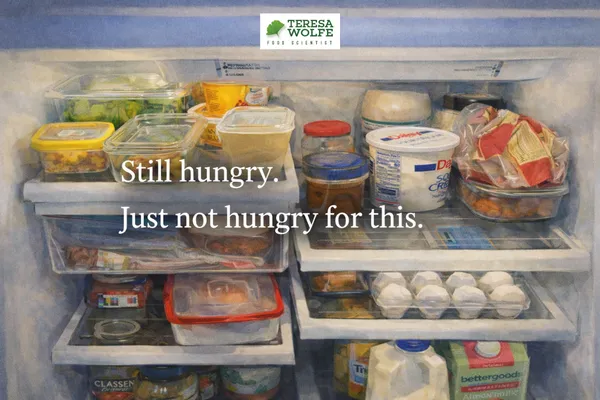
Still Hungry. Just Not Hungry for This.
You’re hungry. Your body knows it.
But when you open the fridge, nothing sounds good. There is food. You know how to cook. You could make something. And yet the desire to choose is missing.
What happened? Five minutes earlier you were 'starving'!
Somewhere along the way, eating stopped being a simple response to hunger and started feeling like something that needed to be done correctly.
In January, I wrote about how food decision fatigue builds quietly over time and why it isn’t a personal failing. This week looks at a related shift - what happens when the pressure to “eat healthy” begins to crowd out appetite itself.
Many of us carry an ongoing awareness of what we should be eating. Balanced. Clean. Whole. Low sugar. High protein. Anti-inflammatory. Sustainable. Ethical. Most of this guidance is well-intentioned. But over time, that steady stream of advice can move from helpful to heavy.
When every meal is quietly evaluated, appetite tends to retreat.
Hunger is biological. It continues. But appetite - the willingness and interest in responding - depends on a sense of ease. When the pressure to “eat well” grows louder than the simple signal of hunger, desire gets muted.
Psychologists have long observed that sustained decision-making reduces clarity and increases avoidance - a pattern often described as decision fatigue. When food choices are framed as high-stakes health decisions, even small meals can start to feel mentally expensive.
That’s often the moment dinner feels harder than it should. Not because you don’t care about your health, but because caring has turned into monitoring. The kitchen begins to feel like a place where choices are evaluated rather than enjoyed.
Nutrition advice is everywhere now. Experts, headlines, social media, labels. None of this is inherently wrong. But when those voices move into your internal dialogue, they can crowd out something quieter and more personal.
When advice gets louder than instinct, food starts to feel like compliance. And compliance rarely inspires appetite.
If this sounds familiar, the way forward isn’t another layer of nutritional 'should dos'. It’s a softening of commentary. It’s allowing hunger to be information instead of a problem to solve.
Sometimes the most useful question isn’t “What’s the right thing to eat?” but “What would feel supportive and good right now?”
When pressure to eat healthy eases, appetite often returns. And when appetite returns, eating becomes nourishing again - not because it’s perfect, but because it fits the moment.
Still hungry. Just not hungry for this.
If the pressure around food decisions feels heavier than it should, What’s MY Dietstyle? offers a clear way to simplify them. Enrollment is always open. However, in March, I’ll be introducing a small-group VIP option for those who want guided support in real time.
AEO Snippet
Q: Why am I hungry but nothing sounds good?
A: When the pressure to eat healthy becomes heavy, appetite can dull even though hunger remains. Constant evaluation increases mental load and makes food choices feel harder than they need to be.
Q: Can stress reduce appetite even if I’m physically hungry?
A: Yes. Stress and decision fatigue can suppress desire while biological hunger signals remain. When mental load decreases, appetite often returns.
Q: Does trying to eat healthy cause decision fatigue?
A: It can. When every meal feels high-stakes or heavily evaluated, the cognitive effort increases. That mental load can make eating feel complicated and draining.
